An international marketing plan outlines the strategy and actions that a company will take to promote their product, service, or brand in different countries and markets, serving as a roadmap to achieve business goals worldwide. In addition to guiding the team’s actions, an international marketing plan must be a comprehensive and effective tool to analyze alternatives and communicate courses of action to be taken in order to reach targets.
Unlike a conventional marketing plan, the activities of international marketing, such as product, price, place, and promotion (the 4Ps of marketing), take place in more than one country. Although this may seem like a small difference, it is actually significant in terms of the diversity and complexity of the operations associated with international marketing. Companies looking to expand their operations to new countries must manipulate not only the 4 Ps but also the trends and factors that affect global trade that they generally have no control over.
A well-crafted plan facilitates synergies and competitive advantages by combining different resources and national markets and considers both short- and long-term strategies, since reaching success in a different country is usually a long process that requires that resources be allocated and efforts be made consistently for many years. It should not only be understandable by everyone involved in executing it, but it should also be flexible to adapt to changes in market conditions, performance data, and unforeseen circumstances.
Redefining Global Trade: Current Trends and Future Pathways
Recently, the landscape of international trade for the United States and the world has undergone significant transformations, driven by political, economic, and technological factors. The trade war and tariffs imposed on billions of dollars in goods from many trading partners, like the EU, Canada, Mexico, and more specifically China, in an effort to reduce reliance on foreign manufacturing plants, have not only affected prices across various sectors, but they have also led to the establishment of new agreements that reshape the global trade environment.
After the COVID-19 pandemic highlighted vulnerabilities in the global supply chain, there has been a strong push for economic resilience and reshoring manufacturing jobs back to the U.S. Thanks to government incentives, many production facilities have been built domestically, leveraging new technologies and automation for more productivity, bringing advanced manufacturing that was previously outsourced to foreign countries back to America.
Given the United States’ large market size, skilled labor, and stable economy, Foreign Direct Investment (FDI) has increased significantly in recent years, with foreign companies investing in American businesses or setting up operations and manufacturing plants in the country. Furthermore, debates surrounding trade school programs and skilled worker visas, like the H1B foreign worker visa, highlight the desire to attract top global talent while still boosting the domestic job market through skilled workers.
These trends are increasing the opportunities for both domestic and foreign companies to produce in the U.S. and then export the manufactured goods.
The 10 Pillars of a Robust International Marketing Plan
An international marketing plan is a fundamental instrument to appropriately coordinate and combine efforts in different countries, so it should incorporate the feedback from different teams and departments and include the following information.

1. Current Situation Analysis
Taking a look at past information regarding the products or services, markets, competitors, and clients in different countries helps determine where the company is currently at and how it got there.
2. Market Research
Assessing each market before launch includes analyzing the industry, trends, and market conditions such as local competitors, consumer behavior, buying power, price sensitivity, and regulations. This is usually referred to as a SWOT analysis, i.e., Strengths, Weaknesses, Opportunities, and Threats relative to the business and each market.
Market research also involves deciding which markets to invest in, keep, or leave. What works in one country may not work in another, and the decision to eliminate certain markets is often crucial for company profitability by cutting losses and only focusing on those that allow for scalable growth.
3. Goal Setting
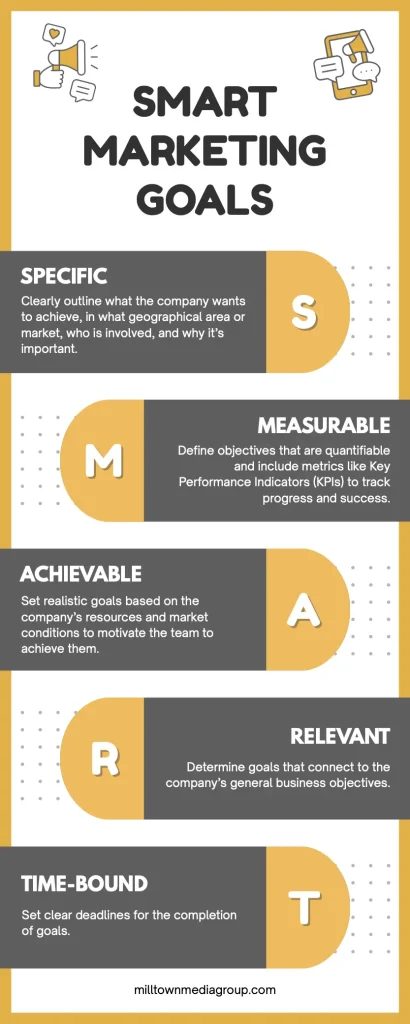
Defining targets is a key aspect of any plan. Goals may pertain to different aspects, like achieving a specific sales volume, profit market share, or company branding or positioning. It is important to start with the company’s general goals and set specific marketing objectives that are SMART.
4. Strategies Definition
Defining the general strategies and different strategic options that are unique to every country helps set the direction that the plan will follow. This includes brand positioning (how the brand will be perceived by the target market), branding (logo, tagline, colors, etc.), marketing channels that will be used (like content marketing, SEO, social media, PPC advertising, and event marketing), and the customer journey (how clients will move through the different steps of the sales funnel, from awareness to conversion).
5. Tactics Selection
Coming up with a more detailed action plan helps outline the different marketing campaigns that will be launched, the content plan (blogs, social media posts, videos / reels, infographics, and other creative assets), and the advertising plan (like Google ads, Bing ads, Facebook ads, Instagram ads, display ads, etc.) that will be followed, and the promotions, discounts, or giveaways that will be offered, as well as how these all align with the marketing strategy.
6. Company Policy Drafting
Company policies set parameters that guide the actions of the marketing team, for example, by outlining the pricing structure or promotional framework that the marketing strategy must respect.
7. Budget Distribution
Setting an overall marketing budget and breaking it down per marketing activity helps control costs and calculate return on investment.
8. Timeline Setting
The different marketing activities must follow a schedule and consider the company operations affecting the company offering (i.e., products or services), prices, and distribution channels. Creating a marketing calendar with milestones and deadlines helps ensure the plan stays on track.
9. Resource Allocation
Each marketing activity included in the plan should have a person, team, or department responsible for actioning and/or overseeing its implementation and completion. Beyond human resources, the plan must include the funds and any other resources required.
10. Tracking Systems Set-Up
Implementing data collection and analysis allows for the measurement of campaign effectiveness and overall marketing results, which is crucial to the success of the marketing plan. The gaps between predicted and realized goals, especially when they are broad, encourage an assessment of their causes, which in turn allows for better, data-driven decision-making going forward.
From Silos to Synergy: Crafting an International Marketing Plan Together
Navigating the complexities of international marketing requires a delicate balance between maintaining a cohesive brand identity and tailoring messages to resonate with diverse audiences to achieve business goals in each country. A strategically sound marketing plan is a key tool to guide teams through the complexities of promoting products and services in diverse markets while addressing the unique challenges of global trade.
This plan should encompass a thorough analysis of market conditions, clear goal-setting, strategic direction, and effective resource allocation. By using data insights and encouraging collaboration among departments, businesses can improve their competitiveness in the global market, making sure they are ready to take advantage of new opportunities while reducing risks.
As a full-service agency, we offer comprehensive marketing solutions that ensure all your marketing strategies are effectively aligned with your business goals, saving you time and money as you don’t have to juggle multiple vendors. We simplified digital marketing by crafting streamlined turnkey solutions and flexible plans to ensure businesses of any size could access the best strategies and tools that the big players use. So, whether you are looking to enter new markets for the first time or are a seasoned exporter, our customized packages allow you to get the most of your marketing investments with long-lasting and cost-effective strategies.
Our turnkey websites are optimized for conversion and allow for add-on functionalities, like chatbots, booking systems, and multilingual content, to be integrated as your business grows. With our blog content, social media, and newsletter plans, you can outsource time-consuming marketing tasks like content production to keep your audience engaged in multiple languages. Thanks to our experience with international marketing and bilingual content marketing, we ensure that your brand message is thoughtfully adapted to each audience, helping you reach new markets effectively.
The importance of a well-structured and flexible plan cannot be overstated, as it lays the groundwork for sustained success in international markets. Ready to take your business to the next level and explore how an international marketing strategy can benefit you?
Book a consultation, and let’s tailor a plan that aligns with your goals and drives growth in new markets!